
Apps Games Articles
MyChart
Epic Systems Corporation
Rating 4.5star icon
Editor's summary
Editor rating
star icon star icon star icon star icon
half star icon
4.5

One-line summary MyChart is one of the most useful medical apps you can put on your phone thanks to its excellent messaging, records, and appointment tools, but its value still depends heavily on how much your healthcare provider actually enables.

  • Installs

    10M+

  • Developer

    Epic Systems Corporation

  • Category

    Medical

  • Content Rating

    Everyone

  • Latest version

    11.7.1

  • Package

    epic.mychart.android

In-depth review
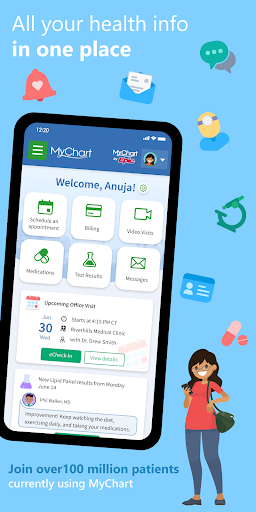
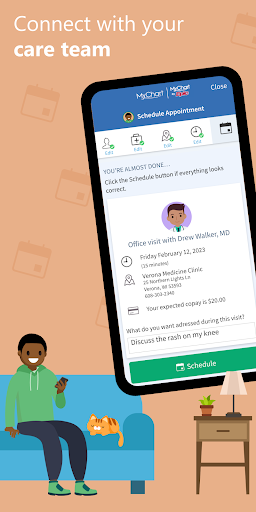
MyChart is the rare healthcare app that feels like it was designed for real life instead of administrative convenience. After spending time with it as a daily medical companion rather than a once-in-a-while portal, the biggest takeaway is simple: when your hospital or clinic fully supports it, MyChart dramatically reduces the friction of managing healthcare. That starts with the basics. The app does a very good job of bringing the most important information to the front: upcoming appointments, test results, messages, medications, billing, and visit summaries. In practice, that means fewer moments of digging through emails, paper handouts, or office voicemail menus just to answer simple questions like, “What time is my appointment?”, “Did my lab result come back?”, or “What did the doctor say after that visit?” MyChart turns those little uncertainties into quick taps. The strongest part of the experience is communication. Messaging your care team is far more pleasant here than making a call, waiting on hold, or trying to remember a non-urgent question during business hours. In use, the messaging flow feels direct and natural: open the app, write the question, send it, and move on with your day. For anyone who prefers written communication, gets anxious on phone calls, or is helping manage care for a parent or child, this is a major quality-of-life upgrade. It also helps that the app makes the rest of care coordination feel connected to that same experience. Scheduling, rescheduling, refill requests, and reviewing follow-up instructions all live in one place instead of being scattered across different systems. Another clear strength is how useful MyChart is as a personal health archive. Test results are easy to find, appointment histories are organized logically, and after-visit notes can be genuinely valuable if you tend to forget what was discussed in the exam room. In everyday use, this is one of those apps that becomes more valuable over time. The longer you use it, the more it becomes a running record of your care rather than just a login screen for your provider. That long-view convenience matters, especially for anyone managing chronic conditions, multiple specialists, regular labs, or family care responsibilities. The app also deserves credit for usability. Medical apps often feel sterile, dated, or overloaded with clunky menus, but MyChart is generally clean and approachable. Navigation is straightforward enough that even less tech-comfortable users should be able to check appointments, read messages, and pull up lab results without much confusion. Logging in can also be made relatively painless with biometrics or a passcode, which matters more than it sounds when you're opening a health app repeatedly instead of once every few months. That said, MyChart is not perfect, and its biggest flaw is one it never fully escapes: the experience depends heavily on your healthcare organization. One provider might expose a rich, well-integrated set of tools, while another may offer a much thinner version of the same app. In practical terms, that means two people can both be “using MyChart” and have very different experiences. Some will be able to schedule visits, handle refills, review detailed notes, and manage bills with ease; others may find that certain tabs are sparse or certain tasks still push them back to phone calls or external systems. That inconsistency can be frustrating because the app itself often feels ready, but your provider’s implementation may not be. The second weakness is notification overload. Reminders are useful, and MyChart is genuinely good at keeping appointments and updates visible, but it can drift from helpful to noisy. Depending on your setup and how many providers are connected, the app may feel a little too eager to remind you of every step in the care process. This is better than missing something important, but it still takes some tuning on the user’s part to keep it from becoming background clutter. The third weakness is that some information presentation still feels more functional than elegant. While results are easy to access, comparing them over time is not always as fluid or visual as it could be. For an app that already does so much to centralize records, it would benefit from richer trend views and easier side-by-side interpretation of historical data. Similarly, there are moments where you want a little more freedom in how you save or share information, but the app remains understandably cautious because of the sensitive nature of medical records. That caution is reasonable, but from a user perspective it can make simple tasks feel more restrictive than they need to. Who is MyChart for? It is best for patients who actively manage their healthcare, people with recurring appointments, parents or caregivers helping family members, and anyone who prefers messaging over phone calls. It is especially good for users who want one dependable place to check results, request refills, review visit notes, and keep tabs on multiple providers. Who is it not for? If your provider barely supports the platform, MyChart will feel more like a partial portal than a complete healthcare hub. It is also less compelling for people who only see a doctor rarely and do not need ongoing interaction, records access, or appointment management from their phone. Overall, MyChart gets more right than almost any medical app I’ve used. It makes healthcare administration less annoying, communication less stressful, and personal records far more accessible. Its limitations mostly come from the healthcare systems plugged into it rather than from a fundamentally bad app. If your doctors and hospitals support it well, MyChart is not just worth installing—it quickly becomes essential.