
Apps Games Articles
MyQuest for Patients
Quest Diagnostics Incorporated
Rating 4.5star icon
Editor's summary
Editor rating
star icon star icon star icon star icon
half star icon
4.5

One-line summary MyQuest for Patients is one of the more useful medical apps I’ve used because it turns lab results into something you can actually follow over time, though a few rough edges in appointment check-in keep it from feeling fully seamless.

  • Installs

    1M+

  • Developer

    Quest Diagnostics Incorporated

  • Category

    Medical

  • Content Rating

    Everyone

  • Latest version

    4.0

  • Package

    com.myquest

Screenshots
In-depth review
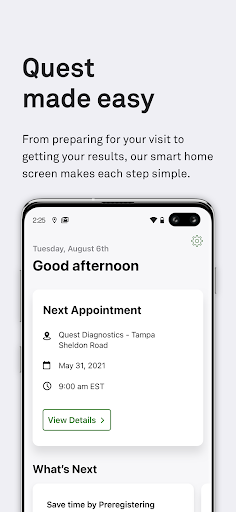
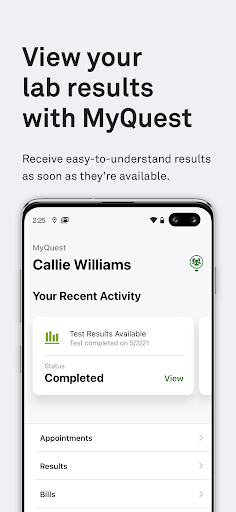
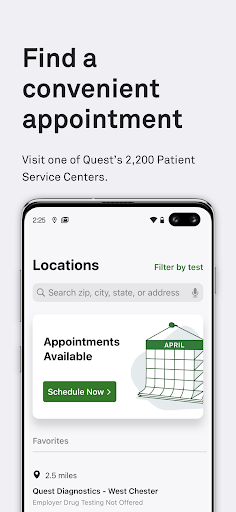
MyQuest for Patients is the kind of healthcare app that earns its place on your phone by being genuinely practical. A lot of medical apps promise convenience and then deliver a clumsy portal wrapped in a mobile shell. MyQuest is better than that. After spending time with it as a day-to-day health utility rather than just a one-time login, what stood out most was how effectively it brings together the parts of the Quest Diagnostics experience people actually care about: seeing test results quickly, tracking changes over time, and handling appointments without extra friction. The app’s biggest strength is that it makes lab data feel readable instead of clinical and buried. Opening results is straightforward, and the presentation does a good job of surfacing what matters first. If a value is outside the normal range, it is clearly flagged, and the color coding makes it easy to scan without having to decode a wall of numbers. More importantly, the app doesn’t stop at dumping out raw values. Tapping into individual results gives useful context, including normal ranges and brief explanations that help translate a lab report into plain-English meaning. That matters because most people do not want to play amateur diagnostician; they just want to understand whether something looks normal, whether it has changed, and what the result generally refers to. The historical view is also one of the best reasons to use MyQuest. Being able to look back at prior results in graph form adds real value, especially for recurring tests where trends matter more than any single number. In practice, this makes the app feel less like a static inbox and more like a personal health record that can help you notice patterns. If you get regular bloodwork, this alone makes the app worthwhile. It gives the experience some continuity, and that continuity is often missing in healthcare tech. Appointments are the second major pillar here, and overall the app handles them well. Scheduling and managing appointments from the phone is exactly the kind of task that should be simple in 2025, and MyQuest mostly gets it right. Finding nearby Quest locations is convenient, and having scheduling inside the same app as your results makes sense. You are not bouncing between systems or trying to remember where you booked something. For routine lab visits, that integration is a meaningful quality-of-life improvement. That said, this is also where the polish slips a little. During my time with the app, the appointment side felt useful but not quite as dependable as the results side. The check-in flow in particular seems to be one of those features that sounds ideal on paper but does not always feel rock-solid in actual use. When it works, it saves time. When it does not, you are back to using an in-person kiosk or another fallback method, which undercuts the promise of a smooth mobile-first experience. It is not a dealbreaker, but it is the clearest example of MyQuest feeling slightly less refined than it could be. A third strength is that the app understands healthcare as something that often involves more than one person. Features around managing care for loved ones make sense in the real world, where family members frequently help coordinate appointments, keep track of results, or share information with providers. There is also clear value in being able to share health information and connect results into a broader health-tracking workflow. Those additions help MyQuest feel more useful as an ongoing tool rather than a narrow single-purpose app. Still, the app is not perfect. One weakness is that while the result summaries are accessible, the overall experience can still feel clinical by nature. That is partly unavoidable in a lab-results app, but there are moments when the interface feels more functional than warm. It does the job, but it does not always guide nervous or less tech-confident users with as much reassurance as it could. A second issue is that some convenience features appear stronger in theory than in execution, especially around check-in reliability. A third complaint is simply that the app is at its best when you are already inside the Quest ecosystem. If your care and testing are spread across several providers and systems, MyQuest can become just one more health app to monitor rather than the single source of truth it wants to be. Who is this app for? It is best for patients who regularly use Quest Diagnostics, especially anyone who wants fast access to lab results and an easier way to watch health trends over time. It is also a good fit for people managing chronic conditions, routine screenings, or family health logistics, since historical results and appointment tools are where it shines most. Who is it not for? If you only get lab work occasionally and do not need to track changes across months or years, MyQuest may feel more utilitarian than essential. It is also not ideal for anyone expecting a flawless end-to-end appointment experience every time, because the mobile convenience can occasionally give way to old-fashioned workarounds. Overall, MyQuest for Patients succeeds because it focuses on usefulness over flash. It gives you quick access to the information that matters, presents lab results in a way that is easier to understand than many clinical portals, and adds enough scheduling and care-management functionality to feel like a real companion app rather than a glorified login screen. The rough edges are real, particularly around mobile check-in consistency, but they do not overshadow the core value. If Quest is part of your healthcare routine, MyQuest is an easy app to recommend and one of the better examples of a medical app doing exactly what patients need it to do.