
Apps Games Articles
Fidelity Investments
Rating 4.2star icon
Editor's summary
Editor rating
star icon star icon star icon
half star icon
empty star icon
3.8

One-line summary Fidelity Investments is easy to recommend for serious all-in-one investing and cash management, but the app’s recent navigation changes and flaky login behavior make it harder to love day to day.

  • Installs

    5M+

  • Developer

    Fidelity Investments

  • Category

    Finance

  • Content Rating

    Everyone

  • Latest version

    3.80

  • Package

    com.fidelity.android

Screenshots

In-depth review
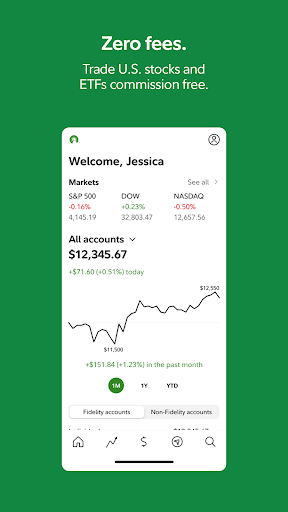
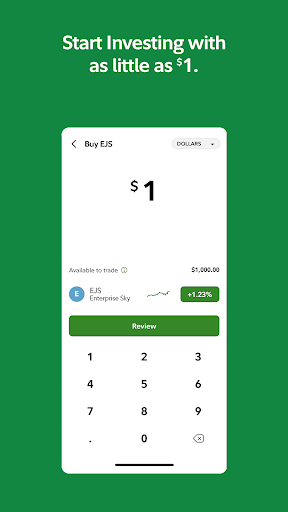
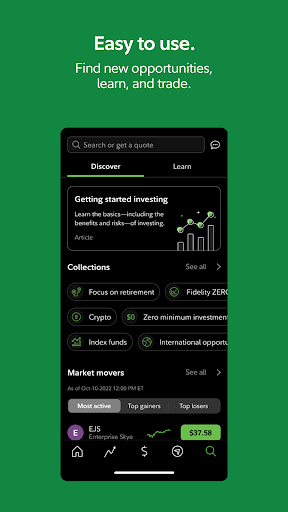
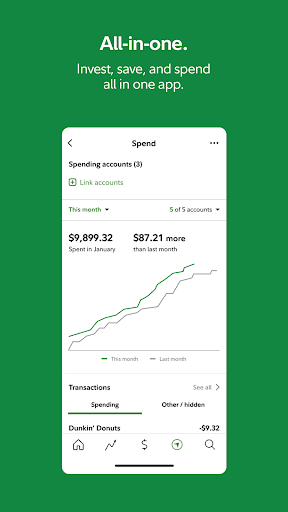
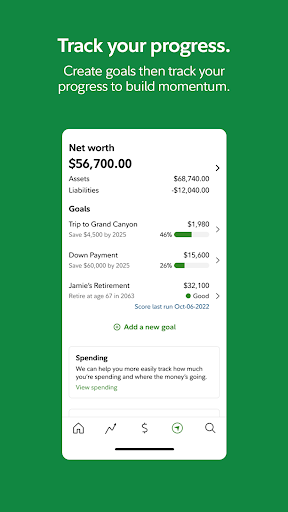
Fidelity Investments aims to be the kind of finance app you can live in: brokerage, research, transfers, bill pay, alerts, planning tools, and even crypto access under one roof. After spending time with it as a daily-use finance app rather than just a place to check balances, my reaction is largely positive, but not without friction. This is a capable, mature app that feels built for people managing real money and multiple financial tasks. At the same time, some design and reliability issues get in the way of what should be a smooth routine. The first thing that stands out is scope. Fidelity is not a one-trick investing app built around flashy stock charts or gamified trading. It feels more like a portable version of a large financial platform. You can move from monitoring investments to handling cash management tasks without feeling like you’ve left the main experience. For users who want one app for investing, saving, transfers, check deposits, bill payments, and account oversight, that breadth is genuinely useful. There is a practical, grown-up quality to the app that many lighter finance apps don’t match. That broader financial focus is also one of its biggest strengths. During regular use, the app gives the impression that it was designed for people who don’t just want to place a trade and leave. It supports the rhythm of ongoing account management: checking holdings, watching markets, moving money, setting alerts, and reviewing account activity. The built-in research angle also helps the app feel more substantial. Even if you are not making trades every day, there is enough here to support informed decision-making rather than impulse tapping. A second strength is that Fidelity generally presents itself as a serious, security-conscious platform. In a finance app, that matters. Features like two-factor authentication and biometric login are not glamorous, but they help the app feel trustworthy. The interface, when it behaves properly, reflects that same tone: professional, information-dense without being chaotic, and aimed at people who care more about control than entertainment. If you are the kind of user who values confidence and structure over trendiness, Fidelity’s approach will likely appeal to you. The third strength is convenience. It is genuinely nice not to juggle separate apps for investing and basic money movement. Being able to handle transfers, deposits, and routine account actions inside the same environment as your portfolio creates a sense of continuity. The app is at its best when it fades into the background and simply lets you manage your finances efficiently. But this is also where the weaknesses become more noticeable, because this kind of app depends heavily on consistency. One problem I ran into was login friction. Biometric authentication should be a quick, invisible part of the experience, and when it fails or falls back to repeated password prompts, the whole app feels clumsier than it should. In a financial app, any repeated login weirdness becomes especially irritating because users open it often and usually for short tasks. If you just want to check a balance, confirm a move, or glance at the market, having the app bounce you into password entry or log you out too quickly breaks that flow. The second weakness is navigation. Fidelity’s app is dense because it covers a lot, but density only works when the structure is intuitive. In practice, some recent layout choices feel less direct than they should. Tasks that ought to be one or two taps away can start to feel buried. Tabs and sections don’t always surface the most important account actions clearly, and there are moments where the app seems more interested in reorganizing information than in helping you get to what you already know you need. For an app built around repeat habits, even small navigation missteps become tiring over time. The third weakness is that the app can feel slightly overbuilt for casual users. That is not the same as being bad; it simply means Fidelity is more comfortable when used by people who already think in terms of accounts, holdings, transfers, and long-term planning. If your ideal finance app is lightweight, extremely visual, and focused on just a handful of tasks, Fidelity can feel heavier than necessary. There is a lot here, and not all of it is equally approachable at first glance. Who is this app for? It is best for existing Fidelity customers, long-term investors, and people who want a comprehensive finance app rather than a stripped-down trading tool. It also makes sense for users who appreciate research, alerts, and serious account management features in one place. Who is it not for? Beginners looking for the simplest possible investing experience may find it more complex than they want, and anyone with low patience for login bugs or shifting navigation will notice the rough edges quickly. Overall, Fidelity Investments remains a solid, useful app with real depth. It succeeds because it gives you meaningful control over investing and money management in one place, and it mostly feels like software built for adults handling important financial tasks. But it does not always feel as smooth as a top-tier mobile experience should. When the login works cleanly and the navigation clicks, it is excellent. When those pieces slip, the app becomes more effortful than a daily-use finance app can afford to be. I would recommend it, especially if you are already in the Fidelity ecosystem, but with the clear warning that the experience is strong in substance and only somewhat uneven in execution.