Apps Games Articles
Sound Meter
Splend Apps
Rating 4.8star icon
Editor's summary
Editor rating
star icon star icon star icon star icon
half star icon
4.5

One-line summary Sound Meter is an easy app to recommend because it turns your phone into a genuinely useful everyday noise gauge in seconds, but I’d hesitate if you need lab-grade accuracy or reliable readings at very high volume.

  • Installs

    10M+

  • Developer

    Splend Apps

  • Category

    Audio

  • Content Rating

    Everyone

  • Latest version

    2.17

  • Package

    com.splendapps.decibel

Screenshots
In-depth review
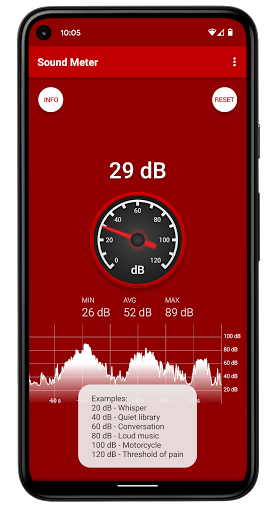
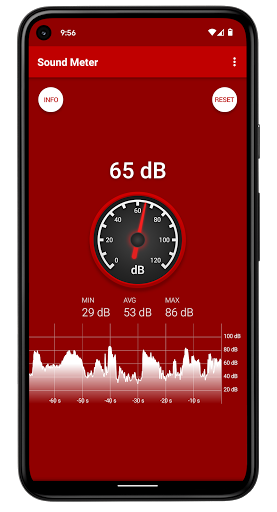
Sound Meter succeeds for the same reason many utility apps fail: it gets out of the way. After spending time with it in ordinary, messy real-world situations—checking room noise, comparing appliance sound, monitoring traffic spill into a bedroom, and generally satisfying that familiar “how loud is this, actually?” curiosity—I came away impressed by how fast and usable it feels. This is not a flashy audio lab stuffed with intimidating controls. It is a practical decibel meter built around a simple idea: open the app, point your phone roughly in the direction of the noise, and get a reading you can understand immediately. That simplicity is the app’s biggest strength. The main screen gives you an at-a-glance reading in a format that makes sense even if you have never used a sound meter before. The analog-style dial is intuitive, and the digital readout keeps it from feeling vague. More importantly, it is not limited to a single live number bouncing around wildly. During testing, the minimum, average, and maximum values made the app much more useful than a novelty meter. A passing truck, a running fan, a burst of shouting, or a TV turned up too high all create shifting sound, and Sound Meter does a good job of turning that movement into something readable instead of chaotic. The graph is the second thing that elevates it above throwaway utility apps. It gives short-term history in a way that is genuinely handy. If a noise source is intermittent, you do not have to stare at the screen waiting for the perfect moment. You can let it run for a bit and see the pattern. That made it useful not just for one-off checks, but for rough comparisons: one room versus another, windows open versus closed, one appliance setting versus another. In everyday use, that history view makes the app feel like a tool rather than a gimmick. The third major win is how approachable it is. Sound Meter feels designed for normal people, not just audio hobbyists. You can hand it to someone with zero context and they will understand what they are looking at within seconds. That matters more than it sounds. A lot of measurement apps are technically capable but visually cluttered; this one keeps the learning curve low. Even the free version remains broadly usable because the ads are not so aggressive that they ruin the experience. They are there, yes, and I would not call them elegant, but they do not constantly derail the core task. Still, the app is not a substitute for a proper calibrated decibel meter, and it does not pretend especially well when pushed outside casual use. The biggest limitation is accuracy. For relative comparisons, it works well enough to be practical. If you want to know whether one air conditioner is louder than another, whether your living room is noisier at night than in the afternoon, or whether your speaker setup is roughly balanced, it can help. But the moment you need precise, defensible numbers, you run into the hard reality that this app depends heavily on your phone’s microphone and whatever processing your device applies. Different phones will behave differently, and that matters. A second weakness is the ceiling on very loud sounds. The app’s own warning about hardware limits is important, and in use it is something you have to keep in mind. This is not the app I would trust for measuring extreme noise exposure or anything safety-critical around loud tools, live events, or industrial environments. If your goal is serious hearing protection decisions, rough consumer-phone readings are simply not enough. The third complaint is that while the interface is clean, it is also a little conservative. It feels polished, but not especially flexible. During use, I found myself wanting a few more quality-of-life touches: more display customization, easier review of past readings, and a more refined experience for extended monitoring. The app is excellent at “measure what is happening right now,” but less satisfying if you want deeper analysis or more control over how the information is presented. It stays simple by design, which is good, but there are moments when that simplicity borders on limitation. Who is this app for? It is for curious homeowners, tenants dealing with nuisance noise, parents, commuters, hobbyists, and anyone who wants a quick, understandable sense of how loud their environment is. It is also useful for light AV tinkering, rough speaker comparisons, checking how noisy a fan or exhaust is, or documenting patterns over a short period. In all of those situations, Sound Meter feels convenient, fast, and surprisingly helpful. Who is it not for? Audio professionals who need calibrated readings, workplace safety use cases, legal-grade measurement, or anyone expecting scientific precision from a phone microphone should look elsewhere. If your use case depends on exact decibel accuracy rather than practical approximation, this app is the wrong instrument. What I like most about Sound Meter is that it knows its lane. It is a consumer-friendly sound meter that feels dependable within the limits of a smartphone. It opens quickly, presents the information clearly, tracks short-term changes well, and avoids turning a simple task into a technical chore. What holds it back from a near-perfect score is not sloppiness; it is the unavoidable gap between “useful phone utility” and “real measuring instrument,” plus a slightly bare-bones approach to advanced controls. For most people, though, Sound Meter nails the brief. It is one of those rare utility apps that can be both casual and legitimately useful, and after using it, I can see why so many people keep it around instead of deleting it after five minutes.
Alternative apps
  • Decibel X
  • NIOSH Sound Level Meter
  • Sound Meter & Noise Detector