Apps Games Articles
Clash Royale
Supercell
Rating 4.5star icon
Editor's summary
Editor rating
star icon star icon star icon star icon
half star icon
4.5

One-line summary Clash Royale is easy to recommend for its fast, brilliantly readable battles and satisfying strategic depth, but harder to recommend if you dislike progression pressure and the frustration of hitting occasional balance and upgrade walls.

  • Installs

    500M+

  • Developer

    Supercell

  • Category

    Strategy

  • Content Rating

    Everyone 10+

  • Latest version

    130300016

  • Package

    com.supercell.clashroyale

Screenshots
In-depth review
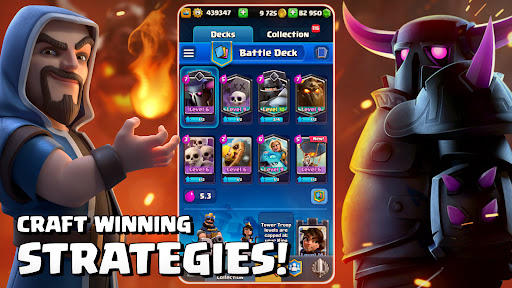
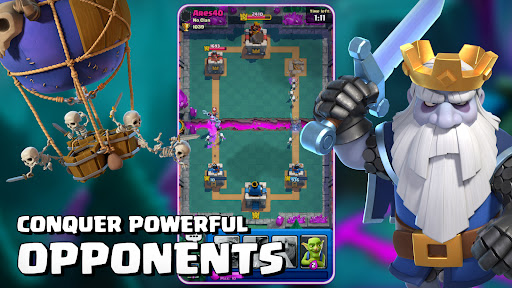
Clash Royale remains one of the cleanest and most immediately engaging competitive mobile games you can pick up. After spending real time with it, what stands out most is how quickly it gets to the point. You open the app, build a deck, jump into a match, and within a few minutes you have either pulled off a clever win or watched your plan fall apart because you mistimed one decision. That speed is a huge part of the appeal. This is not a game that asks for a long session before it becomes interesting. It creates tension almost instantly, and that makes it unusually well suited to phones. The core experience still feels smart and polished. Matches are short, readable, and built around constant tradeoffs. Even when the action gets hectic, it is usually clear why you are winning or losing. That clarity matters. A lot of mobile competitive games bury strategy under visual noise or too many layered systems, but Clash Royale generally keeps the battlefield understandable. We found ourselves repeatedly coming back because losing rarely felt random. More often, it felt like we overcommitted, wasted resources, or failed to respond to the opponent’s tempo. That kind of loss is frustrating, but it is also what makes the game compelling. It gives you a reason to queue again and fix your mistakes. One of the app’s biggest strengths is just how good the moment-to-moment design feels. Deploying a unit at the right second, forcing out a response, then turning defense into a counterpush has a satisfying rhythm that few mobile strategy games match. The game does an excellent job of making smart decisions feel visible and rewarding. You can tell when a match is slipping away, and you can also feel when you have wrestled it back through better timing and placement. That feedback loop is sharp, and it is the main reason Clash Royale stays fun well beyond the first impression. A second major strength is accessibility. Even if you are new, the basics are easy to understand: manage your resources, pressure lanes, defend efficiently, and protect your towers. The controls are intuitive on a touchscreen, and the presentation helps. Characters and effects are distinct enough that the battlefield rarely feels unreadable on a small display. This is a game with real tactical nuance, but it does not demand a huge learning investment before you can enjoy it. That balance between approachability and depth is one of its best achievements. The third strength is the structure of play itself. Because battles are quick, Clash Royale fits naturally into short breaks. You do not need a 30-minute commitment to feel like you accomplished something. A couple of matches can be exciting, and a longer session can be genuinely absorbing because deck choices, matchup reads, and small strategic refinements start to add up. It is one of those games that works both casually and competitively, depending on what you want from it on a given day. That said, the app is not frictionless, and the biggest issue is progression pressure. Clash Royale is free to download, but as you spend more time with it, the gap between wanting to experiment and being able to fully support that experimentation can become annoying. Strategy games are most fun when they invite creative deck building, and here that freedom can feel constrained by upgrade demands. We often wanted to try different combinations more aggressively, but practical progress nudged us toward sticking with what was already viable. That can make the experience feel narrower than the design itself deserves. A second weakness is how punishing the game can become when you hit a rough stretch. Because matches are short and highly competitive, frustration can pile up quickly. A few bad games in a row can make the app feel less like a clever strategy game and more like a stress generator. The same intensity that makes wins satisfying also makes losses sting. If you are sensitive to ladder pressure, ranking anxiety, or repeated close defeats, this can stop feeling fun faster than slower-paced strategy titles. The third complaint is that balance and matchup feel can sometimes get in the way of enjoyment. The game is at its best when both players have room to adapt, but there are stretches where certain interactions or deck styles can make matches feel more rigid than they should. Even when the overall design is strong, there are moments where you feel pushed into reactive, repetitive play rather than creative play. That does not ruin the app, but it does make some sessions feel less fresh than others. Visually, Clash Royale is still attractive in a practical way. It is colorful without becoming messy, animated without becoming chaotic, and expressive without interrupting play. The audio and visual feedback help every action land. More importantly, the interface does not fight you. Menus are straightforward, collecting rewards and managing your deck is simple enough, and the app generally respects your time in the sense that the path from launch to battle is quick. Who is this for? It is for players who want competitive mobile gaming in short bursts, enjoy tactical decision-making, and do not mind steadily learning a system through repeated matches. It is especially good for people who like strategy but do not want a sprawling, slow-moving experience. Who is it not for? Anyone who dislikes progression systems, hates losing streaks, or wants a purely relaxed game should probably look elsewhere. If you want something you can dip into without emotional spikes, Clash Royale may feel too intense and too demanding. In the end, Clash Royale earns its reputation because the fundamentals are excellent. The battles are quick, the strategy is real, and the mobile execution is still among the best in its class. Its frustrations are also real: progression can feel restrictive, competitive pressure can wear you down, and some matchups can leave you annoyed rather than impressed. Even so, after extended use, we came away feeling that the app gets far more right than wrong. When it clicks, it delivers exactly what a great mobile competitive game should: tension, clarity, and that irresistible urge to play just one more match.