
Apps Games Articles
djay - DJ App & AI Mixer
Algoriddim
Rating 4.0star icon
Editor's summary
Editor rating
star icon star icon star icon star icon
half star icon
4.5

One-line summary djay is one of the rare mobile DJ apps that genuinely feels performance-ready, but its best tricks are gated by device compatibility and a subscription model that can make casual users hesitate.

  • Installs

    10M+

  • Developer

    Algoriddim

  • Category

    Audio

  • Content Rating

    Everyone

  • Latest version

    5.3.3

  • Package

    com.algoriddim.djay_free

In-depth review
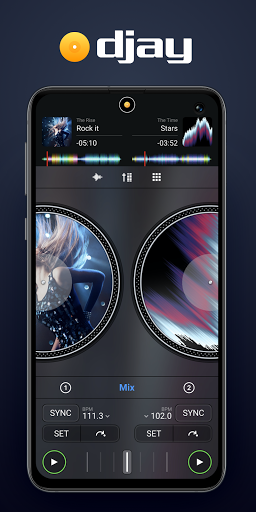
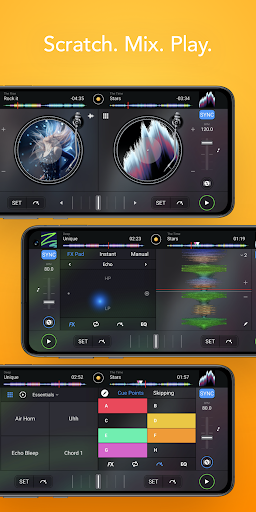
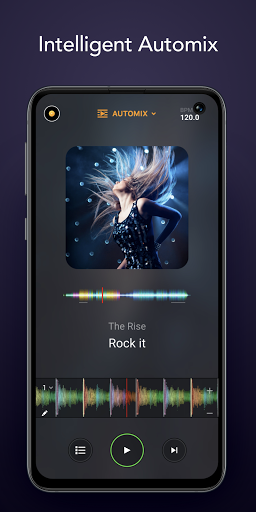
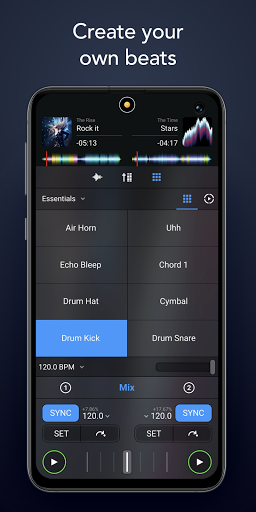
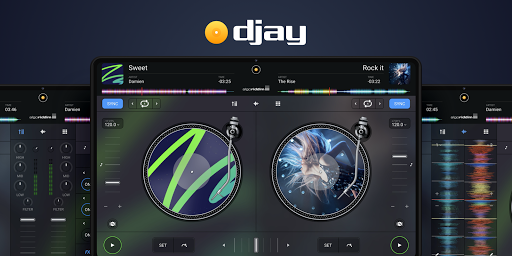
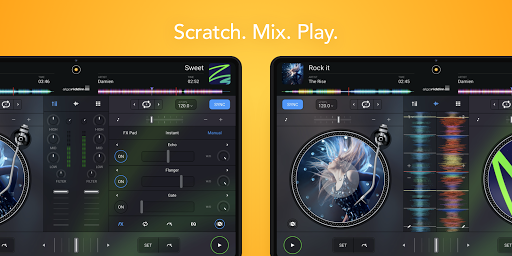
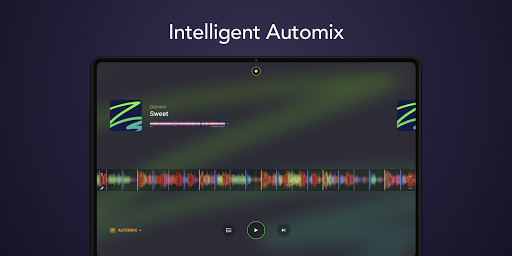
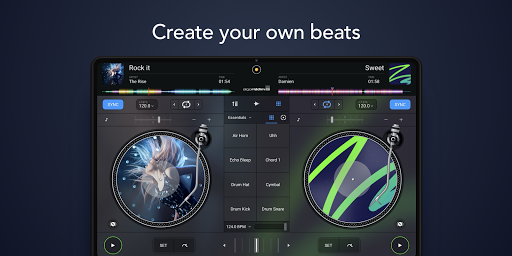
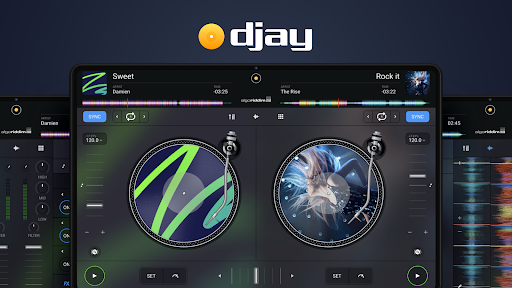
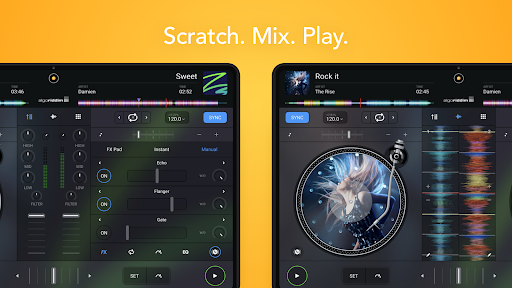
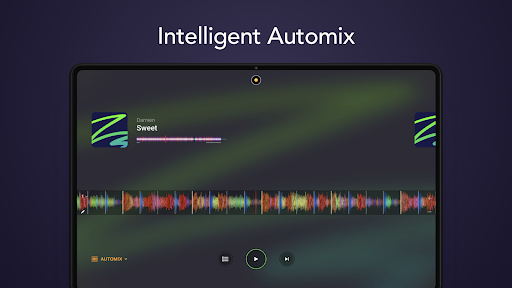
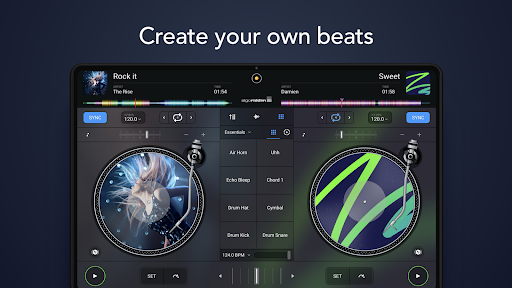
After spending real time with djay - DJ App & AI Mixer, the biggest surprise is how quickly it stops feeling like a toy. Plenty of mobile DJ apps give you two fake turntables and a crossfader, then fall apart the moment you ask them to behave like actual music tools. djay goes much further. It feels like an app built by people who understand both beginner curiosity and real DJ workflow, and that shows in the moment-to-moment experience. The first thing I noticed was how approachable it is. The layout is busy in the way DJ software often is, but it rarely feels chaotic. Within a short session, I was loading tracks, syncing beats, nudging transitions, setting loops, and getting comfortable with the mixer. That matters because this is the kind of app many people will open either out of nostalgia or curiosity, and djay does a good job of making that first mix feel achievable rather than intimidating. There is enough visual feedback in the waveforms, deck movement, and mixer section to make experimentation enjoyable even if you are rusty or completely new. That ease of use is the app’s first major strength. It does not talk down to beginners, but it also does not hide the good stuff. Once I moved beyond basic transitions, the app kept opening up. EQ, filters, cue points, looping, effects, tempo control, and beat matching all feel like part of a coherent system rather than a pile of disconnected features. On a larger phone or tablet, the interface becomes dramatically more comfortable. It starts to resemble a genuinely portable practice rig instead of a novelty. If you have a foldable or a tablet, the experience is better still because the decks and waveforms have room to breathe. The second major strength is how polished the core mixing experience feels. Beat matching and transitions are smooth, and the app is responsive enough that I never felt like I was fighting touch input. That is a huge deal for DJ software. If a fader lags or a platter feels mushy, the whole illusion breaks. djay mostly avoids that. Even when using it casually, it gives you enough confidence to try more than just autoplaying from one track to the next. The Automix feature is also more useful than I expected. In weaker apps, auto-mixing feels like a glorified shuffle button with clumsy fades. Here, it is clearly designed to keep energy moving in a way that feels musically aware. It is not a replacement for a human set, but it is actually pleasant for background playback and helpful if you want the app to carry some of the work. The third standout is the creative ceiling. Neural Mix stem separation, live effects, loops, and sequencing tools add a layer that pushes djay beyond simple playback. Pulling apart vocals, drums, and instrumentals in real time can be genuinely fun, especially when you are testing transitions or building quick mashups on the fly. When it works on a supported device, it feels modern and ambitious rather than gimmicky. This is one of the clearest examples of djay trying to offer something that feels fresh instead of merely simulating old hardware. That said, the app is not friction-free. Its first real weakness is that some of its headline features depend heavily on your device. On capable hardware, djay can feel slick and powerful. On older or less compatible phones, some advanced functions are limited or unavailable. That creates a slightly uneven reputation because the experience can vary a lot depending on what Android device you are holding. Neural Mix in particular is exciting in theory but not universal in practice, so some users will see the app’s best feature set while others get a more basic version. The second weakness is audio setup complexity. djay supports serious use cases like pre-cueing with headphones and external interfaces, which is great, but Android audio routing is still not as seamless as it should be. In practice, getting the exact output behavior you want can be fiddly, especially if you are using adapters or reconnecting gear. For casual home mixing this may not matter much, but for anyone hoping to treat their phone as a semi-serious mobile DJ rig, the setup experience can feel more fragile than the app’s interface suggests. The third complaint is the app’s monetization and feature access. The free version is good enough to show why people love djay, but if you want the full experience, the optional Pro subscription hangs over the app. That is not unusual today, but it still creates hesitation, especially for hobbyists who just want a capable mixing app without another recurring payment. There is also the broader issue of streaming integrations and feature availability evolving over time, so anyone choosing djay mainly for access to specific music services should double-check what matters most to them before fully committing. Who is this app for? It is excellent for beginners who want to learn the basics of beat matching and transitions without buying hardware. It is also great for hobbyists, lapsed DJs, and working DJs who want a surprisingly competent sketchpad or backup setup on a phone or tablet. If you enjoy experimenting with effects, loops, and stems, djay is especially rewarding. Who is it not for? If you demand a perfectly predictable pro setup on every Android device, or if you dislike subscriptions and hardware compatibility caveats, this may frustrate you. It is also not the best fit for someone who wants a dead-simple music player with zero learning curve; despite being approachable, this is still DJ software, and it expects some curiosity. Overall, djay is one of the most impressive music apps on Android because it respects the craft. It can be playful, but it is not frivolous. It can be powerful, but it usually stays understandable. Most importantly, it delivers that rare feeling mobile creative apps chase and often miss: after a few minutes, you stop testing it and start performing with it. That alone makes it easy to recommend.
Alternative apps